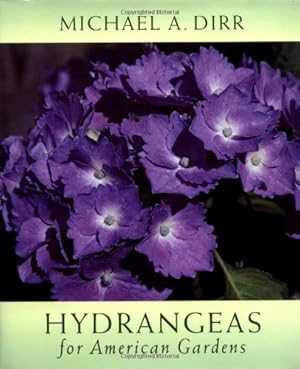
you're want to buy Hydrangeas for American Gardens (Hardcover),yes ..! you comes at the right place. you can get special discount for Hydrangeas for American Gardens (Hardcover).You can choose to buy a product and Hydrangeas for American Gardens (Hardcover) at the Best Price Online with Secure Transaction Here...
Home

Product Details
Publisher: Timber Press
Release date: June 15, 2004
Language: English
Product Dimensions: 9.5 inches x 7.9 inches x 0.8 inches; 1.9 pounds
Shipping Weight: 1.9 pounds
Number of Pages: 240 pages ...
read more Details
Product Description
From Publishers Weekly
Hydrangea is a broad and varied genus, one "difficult to compress under a small umbrella." University of Georgia horticulture professor Dirr casts a wide net to provide comprehensive information about these versatile plants. That his passion for hydrangeas "knows no bounds" is clear from this enthusiastic combination of rigorous science, concise description and seasoned advice. The first chapter, "Characteristics, Taxonomy and Nomenclature," is the most academically oriented but brief and readable enough for the home gardener. Ten well-organized and liberally illustrated chapters follow, each devoted to a single species and its subspecies, ranging from the familiar and hugely popular H.macrophylla and H. paniculata, to relative rarities boasting flower buds that remind Dirr of "purple-brown cauliflowers" and are sometimes "quite large and Martian." Chapters on care and culture, propagation, pests and diseases, potpourri, and breeding offer a wealth of practical insights equally valuable to the casual green thumb and the professional horticulturist, in every region of the country. Readers will learn the often-misunderstood chemistry behind pink/blue color shifts, how to dry and dye flower heads and where to register new cultivars. A first-rate listing of resources and nursery sources and 160 luscious color photos complete this definitive and irresistible tribute to one of America's favorite shrubs.
Copyright © Reed Business Information, a division of Reed Elsevier Inc. All rights reserved.
From Booklist
Mopheads and lacecaps are among the alluring types of hydrangeas that gardeners are enticed to purchase and plant, but not all hydrangeas thrive in the various U.S. climate zones. Dirr directs his authoritative voice and vast knowledge to helping the gardener understand the botany of hydrangea species, as well as the horticultural pluses and minuses of countless cultivated varieties. A bounty of color photographs documents mature climbers, shrubs with lavish foliage, and detailed views of gorgeous inflorescences, including snowballs, while the text covers a fascinating panoply of worthy specimens that embraces the rare and the commonplace. Informative yet entertaining, Dirr's descriptions warn of anemic green leaves and lack of cold hardiness or draw appreciative nods with superb frost tolerance and the frizzy effect of rose to mauve inflorescences with little white eyes. Chapters also provide information on lesser known hydrangeas, care and culture, propagation and pests, and future breeding, as Dirr's reigning expertise in the realm of trees and shrubs comes through once again. Alice Joyce
Copyright © American Library Association. All rights reserved
Review
"The book is filled with information and color images of hydrangeas taken by this accomplished plant photographer, augumented by beautiful botanical illustrations crafted by Dirr's wife, Bonnie. This book is a must for Dirr fans, and for those not yet exposed to his writing and photography, now is the time."
—Richard Churchill, People Places Plants, Summer 2005 (People Places Plants )
"Dirr and his overstated opinions are always a pleasure to read, and this book does not deviate far from those expectations."
—Dan Hinkley, Pacific Horticulture, Spring 2005 (Pacific Horticulture )
"Hydrangeas for American Gardens totally seduced me. It is attractive enough to pick up, deep enough to take home, enthralling enough to take to bed, and by the morning light I wanted it to be mine forever."
—R. William Thomas, American Gardener, September/October 2004 (American Gardener )
“[Dirr] brings the hydrangea story right up to the minute.”
(Muskegon Chronicle )
Product Description
The sheer number of choices among Hydrangea species, hybrids, and cultivated varieties can be overwhelming even for the most advanced gardeners. How to choose from among the hundreds of mopheads, climbers, lacecaps, and oakleafs, to name just a few? And how to care for hydrangeas in American gardens, when nearly all the books offering advice about them come from England and Europe? Respected plantsman Michael A. Dirr comes to the rescue in this refreshingly forthright and practical guide to these distinctive shrubs and climbers.
Book Description
The sheer number of choices among Hydrangea species, hybrids, and cultivated varieties can be overwhelming even for the most advanced gardeners. How to choose from among the hundreds of mopheads, climbers, lacecaps, and oakleafs, to name just a few? And how to care for hydrangeas in American gardens, when nearly all the books offering advice about them come from England and Europe? Respected plantsman Michael A. Dirr comes to the rescue in this refreshingly forthright and practical guide.
From the Author
Michael A. Dirr is a professor of horticulture at the University of Georgia.
About the Author
Michael A. Dirr is a professor of horticulture at the University of Georgia. He is the author of twelve books, including Dirr's Hardy Trees and Shrubs: An Illustrated Encyclopedia and the text and reference book, Manual of Woody Landscape Plants, and has published more than 300 scientific and popular papers and articles. His teaching, lectures, seminars, garden study tours, and plant introduction programs have contributed enormously to greater horticultural awareness. He has received the highest teaching and gardening awards from the University of Georgia, American Society of Horticultural Science, American Horticultural Society, American Nursery & Landscape Association, Massachusetts Horticultural Society, Southern Nursery Association, and Garden Club of America.
Excerpt. © Reprinted by permission. All rights reserved.
Blue or pink colors are predicated on the amount of aluminum in the soil solution which can be absorbed by the roots. Although pH is often listed as the agent of color change, it is actually an instigator of (a precursor to) the process. If soils are acid, aluminum is available; if more alkaline, then aluminum is tied up in insoluble forms and not readily available for uptake. So the true story is that high acidity, i.e., low pH, solubilizes (or makes available) aluminum; the reverse occurs at low acidity (high alkalinity), i.e., high pH. Excess phosphorus in the soil will also tie up the aluminum in insoluble precipitates, even in acid soils. Hydrangea macrophylla grown in pine bark medium, pH 5 to 6, are typically pink. Why? The acidity is high, but almost no aluminum is present in the substrate (bark). Soil is composed of minerals, typically aluminum, silicon, iron, etc., and therein resides the difference. So how do growers produce blue hydrangeas in pine bark? Aluminum sulfate is added to the surface of the container at a prescribed rate, usually 0.75 to 1.5 ounces evenly distributed on the surface of the 3-gallon container medium. Greenhouse growers also apply it as a drench at the rate of 2.4 ounces per gallon solution with 8 ounces applied as a drench per 6-inch container. Greenhouse treatments start at budbreak and continue every 2 weeks for three additional applications. Growers have variable timetables for application but in our work as soon as flower buds are visible, a single application at the 1.5 ounce rate per 3-gallon is made. Water thoroughly after application to ensure solubilization of the aluminum and movement into the root zone. Too much is worse than too little: I have dwarfed and killed plants with excessive applications. Hydrangea macrophylla displays a high tolerance to aluminum. Research showed that aluminum complexes with citric acid in the cell sap and may be detoxified in this manner.
Occasionally, elemental sulfur (flowers of sulfur) is recommended for acidifying the soil and thus mobilizing (solubilizing) aluminum. This is a borderline crazy approach and slow to effect the desired change. If the soil pH is high, live with pink, rose, and red hydrangeas — they are beautiful — or create raised beds, laden with acid organic matter, and apply aluminum sulfate that over time will lower pH and supply aluminum for ready blueing. Hydrangea macrophylla or H. serrata, in any shade of pink to red, is satisfying. Consider nature's gift to the garden, accept and enjoy. On the other hand, if soils are acid as lemons, lime may be added to raise the pH if pink, rose, and red flowers are desired.

incrediball hydrangea perennial huge
Hydrangeas
Add to Cart

0 comments:
Post a Comment